Do Cats Need a Scratching Post? Why Your Cat Scratches, and How to Choose the Best Post
Yes, cats need to scratch. Thankfully, there are ways to get them to scratch the right things.
Yes, cats need to scratch. Thankfully, there are ways to get them to scratch the right things.
by Dr. Maria Zayas, DVM, | July 10, 2026

Laura Stolfi / Stock
Scratching is important to cats as a way to communicate, keep their paws and nails healthy, stretch and exercise their bodies, and release stress as needed. There isn’t an alternative for them to meet those needs, so that’s why every cat parent should know how to give them an outlet to scratch — without sacrificing their sanity or wallet.
It sounds wild, but the trick to avoiding furniture destruction is to give cats other spots to scratch that you both agree on. You can do this with cat trees and scratching posts made from fun materials to scratch (such as sisal rope) and by rewarding them with treats or play for using the scratching surface you’ve chosen.
One secret to having a happy and healthy kitty is to encourage them to scratch — here’s what you need to know to help them.
A healthy cat, mentally and physically, needs to scratch. Scratching is essential for them to relieve tension when anxious. They also engage in many scent-marking behaviors to communicate their space to other cats, and to help them feel calm in their home. Maintaining paw health is likewise critical and depends on them regularly scratching to shed older layers of the nail and remove debris from their nail bed. How else will they retract those sharp claws?
So, if you don’t want them ruining furniture, carpets, rugs, bedding, and more, focus on meeting their needs with a selection of scratching posts and other appropriate scratchable surfaces.
Scratching is a multi-purpose tool for the average kitty. Let’s take a deeper look at why they need to scratch.
Cats are (or at least attempt to be) nimble movers. They want to stalk, jump, sprint, change directions quickly, and walk quietly. They rely on having precise control of their paws and nails to do this, and they maintain that system with scratching.
Unlike many species, cats can extend or retract their nails at will. To do this, though, they need to keep the nail bed free of dirt and debris that could get in the way. The nail itself also needs to fit inside the pouch-like space where the nail lives when retracted, right at the tip of each toe.
To do this, cats shed the outermost layer of the nail by using scratching surfaces, especially ones that are rough or that they can tug on. Cat nails that aren’t exfoliated like this regularly will become much thicker and can stick out, putting them at risk of getting caught in something. These nails will also grow into a paw pad if not trimmed.
Scent glands are located in the base of, and in between, each feline toe. When kitties rub their paw pads — and that space between their toes — into materials, they leave lingering scent messages that are only detectable to other cats and animals with sensitive enough noses. Although you can’t smell these signals, they’re vital for good cat communication.
The main purpose is to warn others about their established territory and to convey negative emotions such as stress and anxiety.

The pros and cons of letting your cat explore the neighborhood (and beyond).
To keep in shape, cats need to use the full range of motion of all their joints as well as regularly use all their muscles to maintain their strength. Cats love scratching surfaces that are taller or longer than they are, with levels to jump to when possible. They’ll climb up to scratch or launch themselves up after scratching, which is so much more satisfying to them. This is because their brains are already wired to include scratching behaviors with play, which is how they practice hunting and social skills.
Cat zoomies include a good, “aggressive” scratching session, so they can stretch and get a workout for their back and shoulders as part of this practice.
Stressed cats will often seek out a scratching surface (like a scratching post) to release their tension. For example, you may notice more scratching from one cat in your home when a new cat or other stressor is introduced.
When cats watch another cat scratch, they can tell if they’re doing it to communicate that they’re stressed. Those scent glands mentioned earlier also leave behind scent signals on the surface for other cats to analyze afterwards.
When they have a chance to communicate effectively, cats often avoid physical conflict or stress-related behaviors like urine marking. This is why scratching is such an important part of health maintenance for cats.
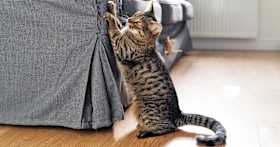
Cats need to scratch to stay healthy, and their instincts will make sure they do so. If they don’t have a scratching post or another surface to scratch, they’ll scratch other things instead. This can include your couch, rugs, carpeting, wallpaper, clothes, even people.
If a cat is isolated from any scratchable surfaces, they can develop stress-related issues like peeing outside the litter box, lashing out at people, urinary discomfort, diarrhea and other gastrointestinal sensitivities, and flare-ups of upper respiratory symptoms.
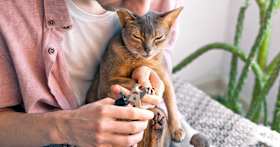
Nails that aren’t maintained with scratching require regular nail trims and cleaning as well — otherwise they can grow into a cat’s paw pad.

Courtesy of RiverNCats
There are actually lots of different scratching surfaces you can provide for your cat.
Scratching posts: Scratching posts generally have a wide base and are vertically oriented, with a round or square post that can be one or more feet tall.
Cat trees: Cat trees often incorporate scratching posts, but also have multiple levels for cats to climb to access more scratching posts. They can also include hides, hammocks, ramps, hanging toys, and more.
Other options: Some other scratching surfaces include corrugated cardboard mats, beds, structures, toys with embedded scratching surfaces, scratching boards that attach to walls or doors, and carpeted structures including cat wheels.
The best scratching post for your cat does depend on their preferences. When getting started, it can help to provide a wide variety of posts and then narrow it down to the ones they like. That being said, there is research data on what most cats like best. If you’d like to know where to start, you’ll find some science-backed tips below.
Vertical scratchers are generally preferred. Depending on the cat, scent marking and stress relief often come with vertical scratchers, whereas stretching and nail exfoliation tend to be preferred on horizontal surfaces.
Don’t forget that some scratchers fall somewhere in-between — like ramps, wheels, and corrugated cardboard structures (such as houses), which provide multiple scratching angles in one product. Although it’s best to provide both, when in doubt and on a limited budget, focus on the vertical scratchers.

A bored cat can develop everything from behavioral issues to physical ailments. Here’s how to keep your kitty mentally stimulated.
Scratching materials need to be rough, catch on the nail enough to be tugged against, and when possible, have a bit of give to them when cats tug. Cats’ most commonly preferred scratching surface is sisal rope (especially well-used and fraying), though older cats may prefer a softer material such as carpet.
In fact, carpet is a commonly loved scratching surface, often incorporated into cat trees. Just keep in mind that if you’re trying to train a cat where to scratch (and where not to), teaching them to have a preference for carpet could make it more difficult for them to avoid inappropriate scratching areas in your home. Their nails can also get caught on carpet, leading to injuries.
Cardboard and wood are less beloved scratching surfaces, but it’s always good to try them in case either is favored by your cat.
Although cats like a material like sisal rope, especially if it isn’t wound super tight and can shift under their nails, the scratching surface itself needs to be sturdy. If it wobbles or is at risk of tipping over with use, cats will quickly learn to avoid it.
In the wild, things like tree trunks are an equivalent scratching surface. Cats want to dig in and pull back hard and ideally not cause the structure to move at all.
The general rule of thumb for height is that the scratching surface needs to be at least as tall or long as a cat can stretch. More specifically, this means it needs to be at least three feet long for most cats. Cat trees with two or more scratching levels are preferred most of all, more than one overwhelmingly long or wide, unbroken surface.

Laura Stolfi / Stocksy
Scratching posts need to be where your cat likes to be and where they want to leave messages for other cats. That will include their favorite rooms, where they sleep (the most important territory for them to “protect”), and the areas they frequently move through.
If you have a cat repeatedly targeting furniture in certain rooms or areas of your home, that tells you that area could use a scratching post.
The best way to encourage a cat to use a new scratching post is to reward them for using it. To start training your cat to scratch, play with them over the space where the scratching post is located. This should get them overstimulated enough to use it.
If they’re unsure about a new item, entice them to the area with catnip or alternatives such as silvervine or pheromone sprays (like Feliscratch), designed to induce scratching behaviors. Once you get them to use the post, promptly give them a treat, a toy, or praise — whatever it is they like best.

Is your new cat scratching everything in sight? It’s natural, but not necessary. Here are proven ways to discourage that behavior.
Discouraging the use of inappropriate scratching spots is not an effective way to change their behavior. To reduce their use of inappropriate scratching spots, encourage approved spots instead. Over time, the more you get them to use preferred scratching spots, the less they’ll touch the other spots.
Placing scratching posts in the general areas they already like to scratch is a helpful way to reaffirm where a scratching post is needed. However, putting a scratching post immediately next to the item you don’t want scratched can lead to the scratching of both areas due to confusion, or even increased scratching on the item you wanted them to ignore.
Indoor and indoor-outdoor cats use scratching posts at about the same rate while they’re inside. It’s important for the health of any cat who spends time indoors to have access to scratching posts.
Although older cats may have less interest due to arthritis and less energy, softer scratching surfaces such as cardboard and carpet, along with encouraging play or sprinkling catnip or spraying pheromones on the scratcher, can often get them interested.
You need at least one scratching post per cat and/or per area they like to play and sleep in. That said, having more than 10 available scratching posts, regardless of the actual number of cats, is associated with a significant decrease in the scratching of surfaces cat parents don’t want damaged.
Declawing is not the answer to the problem of cats scratching things they shouldn’t. Keeping their nails trimmed, applying nail caps if needed, consistently encouraging the use of scratching posts with pheromone sprays, and rewarding a cat when they use a scratching post are the best options to treat this issue without causing pain and significant behavioral complications.
Cozzi, Alessandro, et al. “Induction of Scratching Behaviour in Cats: Efficacy of Synthetic Feline Interdigital Semiochemical.” Journal of Feline Medicine and Surgery, vol. 15, no. 10, 21 Feb. 2013, pp. 872–878, https://doi.org/10.1177/1098612x13479114.
“FELISCRATCH by FELIWAY.” Feliway, www.feliway.com/il/Products/FELISCRATCH-by-FELIWAY?locale=en.
Wilson, Colleen, et al. “Owner Observations Regarding Cat Scratching Behavior: An Internet-Based Survey.” Journal of Feline Medicine and Surgery, vol. 18, no. 10, 11 July 2016, pp. 791–797, https://doi.org/10.1177/1098612x15594414.

Dr. Maria Zayas attended Ross University School of Veterinary Medicine where she completed her veterinary degree in addition to participating in and presenting research related to aquatic animal medicine. She spent her first year as a doctor working with a low cost spay/neuter and general practice clinic before returning to her home state of New York and entering the world of housecall veterinary medicine. Falling in love with this area of medicine, she launched her own housecall veterinary practice in addition to writing pet health articles. She loves all things related to water and continues to travel and explore with her three dogs and one cat, all of whom also love to swim.
Behavior & Training

Behavior & Training

Behavior & Training
Behavior & Training

Pet Wellness
Uncover the truth about declawing cats and its impact on feline well-being.
Adoption Advice
Curious about cat-proofing? Learn how to make your home safe and enjoyable for your cat.

Lifestyle
Find out if Mel Robbins’ mantra applies to cats and dogs.
Adoption Advice
Make nail trimming less stressful for your cat with these easy tips.

Pet Wellness
Communication is key, and pheromones are your cat’s version of DMs.