How to Treat Cats for Fleas Without a Bath
Skip the stress of a bath. These tips can help you get rid of fleas — no water necessary.
Skip the stress of a bath. These tips can help you get rid of fleas — no water necessary.
by Katie Koschalk, | April 18, 2025

larisikstefania / Adobe Stock
Fleas aren’t just annoying — they can lead to serious discomfort and health issues for your kitty, from irritated skin and relentless itching to tapeworms and anemia. That’s why it’s important to tackle an infestation early and take steps to prevent it from coming back. While baths are often considered the go-to solution for flea removal, they aren’t always the best first-line approach for cats.
If you’re a new pet parent, you might not realize that baths can be very stressful for kitties (and humans) and are not always effective. Fortunately, you don’t have to wrangle your cat into a tub to get rid of fleas. There are several effective, bath-free methods to banish those pesky parasites and keep your kitty feeling their best.

Karin Chantanaprayura / Pexels
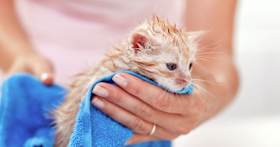
Baths can be an effective way to remove adult fleas from a cat and wash away flea dirt. They’re most useful in cases of severe flea infestations, which are common in stray cats picked up off the streets and cats allowed to go outside. But for many cats, baths aren’t the best flea treatment. Here’s why.
They primarily kill adult fleas: Baths may wash away some larvae and eggs, but they don’t reliably eliminate them.
They’re stressful: Most cats dislike water and may become anxious, frightened, or aggressive during a bath. For kittens, senior cats, or those with medical conditions, bathing can also be risky, as it may cause stress, strain their bodies, or lead to dangerous drops in body temperature.
They remove their scent: Cats rely heavily on their personal scent for comfort and communication. A bath can strip away those familiar smells, leaving cats disoriented or unsettled, especially in multi-cat households.
They’re hard to do right: Bathing a squirmy, stressed cat can be ineffective and dangerous if you’re not experienced. If your cat panics, you risk scratches and bites. And if the bath isn’t done thoroughly, you may not eliminate many fleas.
Fleas are tiny, but the signs of an infestation are hard to miss once you know what to look for. Catching the problem early can help you take action before it gets out of hand.
Excessive scratching or grooming: If your cat is scratching, licking, or biting at their skin more than usual, especially around the neck, tail base, or belly, it could be a sign of fleas.
Flea dirt: This looks like small black specks in your cat’s fur, especially around the back and belly. It’s actually flea feces made of digested blood. You can confirm this by placing some of the black specks on a wet paper towel. If it turns reddish-brown, it’s flea dirt.
Visible fleas: Adult fleas are small (about the size of a sesame seed), brown, and fast-moving. You might spot them darting through your cat’s fur or on a flea comb.
Scabs or skin irritation: Some cats are allergic to flea saliva, leading to inflamed skin, redness, or scabbing, especially near the tail or neck.
Restlessness or behavior changes: A normally calm cat may seem agitated or restless, or suddenly start avoiding their favorite spots if dealing with an itchy infestation.

RDNE Stock project / AdobeStock
Baths aren’t the only way to get rid of fleas on cats. These effective, vet-recommended alternatives can help eliminate fleas and prevent them from returning. When you head to your first vet visit (or for your annual check-ups), don’t hesitate to ask your vet for advice on these flea control methods.
A fine-toothed flea comb is one of the simplest and safest tools for removing adult fleas from your cat’s fur. Comb slowly, focusing on flea-prone areas like the neck, base of the tail, and belly. Keep a bowl of soapy water nearby to dunk the comb and drown any fleas you catch. While this method won’t address flea eggs or larvae, it can help reduce the adult flea population and give your cat some immediate relief.
Topical flea treatments (aka spot treatments), such as Advantage and Frontline, are applied to the cat’s skin at the base of the neck and offer long-lasting protection. These treatments typically kill adult fleas, eggs, and larvae, making these treatments the most effective options.
Most spot-on treatments begin killing fleas within 12 to 24 hours and provide protection for a month. Be sure to choose a product made specifically for cats and appropriate for your cat’s age and weight. Always follow your vet’s guidance or the instructions on the package.
Oral flea medications, such as Credelio and Capstar (which require a prescription), come in pills or chewable forms and are often fast-acting. Some start killing adult fleas within 30 minutes, and will get rid of the majority of adult fleas within six to 24 hours. Protection can last anywhere from a couple of days to a month, depending on the product.
One caveat is that oral flea medications usually don’t target eggs or larvae. They’re best used when you need fast relief from adult fleas or as a temporary solution until you can start a topical treatment that kills fleas at all life cycles. Avoid combining oral and topical products unless your vet recommends it.
Flea collars can offer ongoing protection, because they slowly release flea-killing ingredients over time. Some collars are effective for several months.
However, flea collars come with a few potential drawbacks. Because they’re fastened around a cat’s neck, protection may be strongest around the neck and weaker on other parts of the body. In multi-cat households, there’s also a risk that cats grooming each other could ingest the collar’s chemicals (which can be harmful). Additionally, collars can pose a choking or entanglement hazard during rough play, or if they get caught on something.
Avoid using a flea collar in addition to other flea treatments unless advised by your vet.
When dealing with fleas, it’s important to know you’re not just fighting the adult insects you can see. You’re also up against their eggs, larvae, and pupae, which are often hidden in your cat’s environment.
Adult fleas are the ones you see on your cat. They live on your pet, feed on their blood, and cause the most noticeable symptoms, such as itching and irritation. They only make up about five percent of the total flea population during an infestation.
Flea eggs, on the other hand, are much more numerous, and they’re not laid on your cat to stay there. Female fleas lay dozens of eggs daily, which quickly fall off your cat and into your home (carpets, bedding, furniture, etc.)
Once the eggs hatch, they become larvae and eventually pupae. They lie in wait until they mature into adult fleas and jump onto your cat to continue the cycle.
Why does this matter? If you only treat the fleas you see, you’ll likely miss most of the problem. That’s why effective flea control involves not just removing fleas from your cat, but also breaking the life cycle by addressing the eggs and larvae in their environment.

Valerii Honcharuk/ AdobeStock
Getting fleas off your cat is only part of the solution. You also need to address the home environment to stop the flea life cycle and prevent reinfestation.
Vacuuming is one of the most effective ways to remove fleas, eggs, larvae, and pupae from your home. Focus on carpets, rugs, baseboards, hardwood floor cracks, and especially areas where your cat hangs out. Use a vacuum with strong suction and a crevice tool to get into tight spots.
Be sure to immediately empty the vacuum canister (or dispose of the bag) outside your home to avoid reintroducing fleas. For best results, vacuum twice a day during an active infestation.
Additionally, while optional, steam cleaning after vacuuming can kill fleas and eggs lodged in carpet fibers.
Fleas and their eggs can hide in upholstery and furniture seams. Use vacuum attachments to thoroughly clean couches, chairs, pet furniture, and any soft surfaces your cat uses.
Wash removable covers and cushions in hot, soapy water, and dry them on high heat to kill fleas and their eggs. Use a steam cleaner, if you have one, for furniture that can’t be washed. For extra flea-fighting power, consider using a pet-safe fabric spray designed to kill fleas in the home.
Wash your cat’s bedding and any blankets, cushion covers, or towels they use in hot water. Then, dry them on the highest heat setting. This kills flea eggs and larvae hiding in the fabric. Repeat this process regularly during an infestation, and make it part of your ongoing flea prevention routine.
For more serious infestations, consider using a flea spray, powder, or natural remedy like food-grade diatomaceous earth. These products can help kill fleas in carpets and crevices. (Always choose formulas labeled as safe for pets.) Apply treatments according to the instructions, and keep pets away from treated areas until it’s safe for them to return. In extreme cases, a professional pest control service may be necessary.
While many mild to moderate flea infestations can be managed at home, there are times when it’s best to bring in a professional. You should reach out to your veterinarian for the following reasons.
Your cat is showing signs of a flea allergy, such as scabbing, hair loss, or excessive scratching.
You’ve tried multiple flea treatments, and the problem keeps coming back.
Your cat is very young, elderly, pregnant, or has a medical condition that makes treatment more complicated.
You’re unsure which flea products are safe or most effective for your cat.
Your cat seems unusually lethargic or pale, which could be a sign of anemia from severe flea infestation.
A vet can help you confirm if fleas are the true cause of your cat’s symptoms and recommend the safest, most effective treatment options based on your cat’s age, weight, and health status.
Once fleas go down the drain, they typically can’t survive. When dealing with a flea infestation, it’s important to treat your cat and home thoroughly. Fleas left in the environment (carpet, furniture, etc.) — and not the drain — are what cause reinfestation.
Yes, bathing your cat with unscented dish soap can kill live fleas and wash away larvae, but it won’t prevent reinfestation or address the fleas hiding in your home (where most of the problem lies). Plus, bathing can stress your cat. Flea medication and home treatments are more effective.
You’ll need to treat your cat and their environment simultaneously to permanently get rid of fleas. Use vet-approved flea preventatives, vacuum often, wash bedding, and treat your home. Ongoing prevention is key to keeping fleas from coming back.
It can take several weeks to fully eliminate a flea infestation. Adult fleas may die quickly, but eggs and larvae can linger. You’ll need to consistently treat both your cat and your home to break the flea life cycle.
Yes, fleas can be dangerous to cats. Fleas can cause itching, allergic reactions, skin infections, and in severe cases, anemia, especially in kittens or older cats. They can also transmit tapeworms and other diseases if left untreated.
“Fleas.” Kitten Lady, https://www.kittenlady.org/fleas.
“How Often Should I Bathe My Cat?” Jackson Galaxy, www.jacksongalaxy.com/blogs/news/how-often-should-i-bathe-my-cat?srsltid=AfmBOooYm-snJKfy8IoKao9R-LIfJKs7tGy0tUUHbG-C6UcIJd-cnjBo.
“Keeping Critters Away: The ‘Flea-Free’ Fur Formula.” VCA Animal Hospitals, vcahospitals.com/shop/promotions/parasite-prevention/flea-infestation-is-a-headache-best-avoided.

Katie Koschalk is a freelance writer based in Northern California. Fusing her love and knowledge of animals with her journalism degree and years of professional writing, Katie is dedicated to improving the lives of pets and their caretakers by sharing helpful and accurate information. When she’s not at her desk, you can find her exploring trails with her Aussie, Hunter, cooking plant-based meals, and talking to her two cats, Jax and Sadie, in really ridiculous voices.
Adoption Advice
Pet Wellness

Adoption Advice

Adoption Advice
Worms are common in cats, especially in kittens. Thankfully, freeing your feline from worms is not that difficult.

Adoption Advice
Learn about the key vaccinations and environmental considerations that go into determining when it’s okay for your kitty to venture out of your home.
Adoption Advice
Preparing for a kitten’s first vet visit. Learn about what you can expect from a vet visit and what you should do to ensure it goes smoothly.

Adoption Advice
Bringing home a cat? Here’s what you’ll wish you knew sooner.

Adoption Advice
Thinking about adding another cat to your home? Here’s how to expand your family, minus the drama.

Adoption Advice
Adopting a new cat? Learn more about how you should introduce your adopted friend to their new home.