How to Crate Train an Older Dog
Whether for medical or practical reasons, it is never too late to teach your dog how to comfortably chill in a crate.
Whether for medical or practical reasons, it is never too late to teach your dog how to comfortably chill in a crate.
by Cammi Morgan, expert review by Mia Nguyen, CPDT-KA, FFCP | August 28, 2025

Wabi / Adobe Stock
Crate training isn’t just for puppies. Older dogs can learn to feel comfortable in a crate, too. Whether you’re preparing for emergencies, vet-mandated rest, or want to use one as a safe space for short-term rest or travel, teaching your adult dog to relax and feel safe in a crate is a valuable skill.
Crate training should never be used to confine a dog for extended periods, especially daily. Dogs are social creatures, and overuse of the crate can lead to deep frustration, anxiety, learned helplessness, and other negative outcomes. Instead, crates should be introduced as a primarily choice-based safe space, used briefly during the day or in situations where temporary confinement is necessary, such as medical recovery.
This guide will walk you through how to crate train a dog through patience, positive associations, and respect for your dog’s needs.
You can absolutely crate train an older dog, although it might take more time and patience compared to training a puppy. Still, adult and senior dogs are fully capable of learning to feel safe in a crate. The benefits of crate training your dog include emergency readiness, a safe space for medical recovery, and secure transport and travel. For some older dogs, crating overnight — when senior dogs with dementia or decreased vision are at higher risk of injury — can also ensure their safety. Even if you don’t plan on using a crate regularly, making sure your dog feels safe in one can be critical during unexpected events and post-surgery.
Still, not all dogs react well to crate training, even after slow, careful introductions and positive-association building. If your dog has a history of trauma or neglect, or they panic when confined, crate training might not be suitable. In these cases, consider using an exercise pen, gated-off room, or work with a professional, qualified trainer (or behaviorist) to create a safe space for them.
Crating should never be used to avoid addressing behavioral issues or to move your dog “out of the way.” And it certainly should not ever be used as a punishment. Complicated diagnoses such as separation anxiety, for example, require comprehensive support from canine separation-anxiety specialists, and according to Dr. Terri Bright, a behavior specialist at the MSPCA-Angell, crating is typically contraindicated in these cases.

New rescue dog? Don’t panic — here’s your survival guide for the first few days and how to connect with your new best friend.
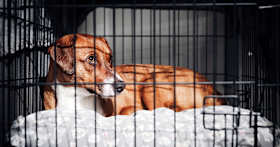
Creating a welcoming, safe, positive environment is the foundation for successful crate training for your older pup. To start, you’ll need to choose the right size crate. Your dog should be able to comfortably stand up without being hunched over or forced to dip their head down. They should also be able to easily turn around and comfortably lie down. A crate that is too small can feel distressing, so it’s important to pick the right size for your pup. Additionally, you should place the crate in a quiet, low-traffic area of the house. Just avoid a spot that is too isolated, because your dog still wants to feel like part of the family.
The crate should have soft bedding or an orthopedic pad for comfort, and make sure to include safe chew toys, enrichment items, or treats for their enjoyment and to build positive associations with being in the crate. Leave the door open as much as possible, so your dog can explore on their own terms.
The key to crate training an older dog is to go slowly and make each step a confidence-building, positive experience.
Start by letting your dog explore the crate at their own pace. Keep the door open, and never force them to go inside. Instead, toss treats or a favorite toy near the crate. Once they are comfortable playing with toys and eating treats near the crate, then toss these items just inside the entrance. Continue this way until your pup is comfortably enjoying their toys or treats inside the crate with the door open.
Once your dog is entering the crate comfortably for brief periods, begin to pair crate time with meals and special, longer-lasting chews. As long as they are comfortable, feed them their meals near the crate at first, then move their meals inside the crate. At this stage, you still don’t want to close the door. You can also use stuffed Kongs, frozen treats, puzzle toys, and other long-lasting enrichment items to build positive associations with longer time spent in the crate.
When your dog is consistently relaxed in the crate for an increasing amount of time, begin closing the door for very short intervals. Start by simply closing the door and immediately opening it again while they are chewing on a treat, working with a snuffle mat, or puzzle toy. As long as they appear comfortable inside at this stage, you can start closing the door for five to 30 seconds, making sure to open it while they still appear calm and content.
Now you can gradually build on the time your dog spends in the crate. One way to do this is by using a slow-feeder to extend the amount of time they spend eating meals, keeping the door closed as they eat. If you have success with feeding them meals or giving them a long-lasting chew with the door closed, you can begin briefly extending this time to after they’ve finished their meals or treat.
Start by keeping the door closed one minute past the end of their meal, then two minutes, then five, and so on. (Decrease this amount of time if your dog shows signs of stress.) Remember, the goal is to build their threshold for comfort through incremental successes — and not force them to endure inescapable stress or anxiety, which can lead to learned helplessness. Make sure to open the door of the crate while they’re still feeling safe, which helps build their confidence and comfort in the long-term with crating.
As you gradually build to several minutes of crating with the door closed, you can begin working on incrementally moving away from the crate. Begin by simply taking a few steps back, and repeat this until you’re sure that your dog still feels safe. It’s best to initially put a new treat or long-lasting chew into the crate as you start this process.
Ideally, build up to at least 10-minute increments of being on the opposite side of the room, before leaving for a different space where your dog can no longer see you. Once you begin moving to a different room, return in view of your pup after just a few seconds. Gradually increase this time, but go back in the process if your dog shows signs of anxiety that last longer than a few seconds.
Ultimately, the crate should primarily be a space your dog can enter and exit of their own free will on a regular basis. Helping your pup learn to feel safe in the crate with the door closed (and pet parents out of sight) is important. This will prepare them for times during which crating is necessary..
Even when pet parents embrace a slow, rewarding, and thoughtful approach to crate training, they might encounter some hiccups along the way. It’s important to listen to what your dog is communicating to you and adjust your training plan accordingly. Crate training should always be a positive experience, and if your dog is showing signs of stress or discomfort, it’s time to reassess.
If your older pup whines, barks, or otherwise vocalizes in the crate, they are likely expressing that they are acutely uncomfortable and not ready for this level of confinement. It’s crucial not to punish whining — vocalizing is communication, not misbehavior.

Your pup’s comfort is extremely important. If they are consistently whining, pawing at the crate, or trembling, that’s a sign to slow down, adjust expectations, and reinforce enjoyable associations to build their comfort. Take a few steps back in your training plan, putting them in the crate for shorter periods and increasing positive associations.
If your older dog hasn’t had adequate exercise, enrichment, and social engagement before going into the crate, they’re more likely to feel stressed in this confined space. If you are still struggling after taking a few steps back and ensuring all their needs are met, consider contacting a qualified positive-reinforcement-based trainer or behaviorist for assistance.
Ideally, it’s best to use closed-door crating only when necessary. This is not a place to keep your dog during the workday or for long hours. Prolonged crating can harm your dog’s mental and physical well-being and decrease their overall quality of life.
For behavioral issues that may necessitate confinement (such as destructiveness from boredom when you’re out of the house), consider alternatives to crating, such as doggy daycare, sectioning off access to some areas of the house, practicing environment management, and working with a qualified positive-reinforcement-based trainer or behaviorist to help your dog. Crating them is not a long-term solution.
No, dogs of any age can be crate trained with the right approach. Senior dogs may take more time, but are often just as adaptable as younger dogs.
The 2:1 rule states that, at a bare minimum, for every hour that your dog spends in the crate, they need at least two hours for exercise, playing, socializing, and rest outside of the crate.
How long it takes to crate train your dog can depend on their history, energy levels, and personality, as well as your consistency and dedication to building positive associations with training. Most older dogs will become comfortable with the crate in one to four weeks.
The fastest way to crate train an older dog is to use high-value rewards, take small steps, and train in short increments at least two times a day. Going slowly and respecting what your dog is feeling is the quickest route for long-term success.
Affective dog behavior. (2021, December 24). “Learned Helplessness” - a new spin on an old theory. ADB. www.affectivedog.com/post/learned-helplessness-a-new-spin-on-an-old-theory.
The MSPCA-Angell. (2024, April 30). Separation anxiety and your dog • MSPCA-Angell. MSPCA-Angell. www.mspca.org/pet_resources/separation-anxiety-and-your-dog.

Cammi Morgan is a nature and pet care writer living off-grid with her pack of rescue and foster dogs in the mountains of Southeast Appalachia. In addition to her work with Adopt a Pet, she has contributed to Animal Wellness Magazine, PetsRadar, Global Comment, A-Z Animals and other online publications. Her passions include animal rescue, mycology, hiking, and caving.
Behavior & Training

Behavior & Training
Behavior & Training

Behavior & Training

Adoption Advice
If you’re feeling overwhelmed or sad after bringing home a new puppy, you’re not alone.
Adoption Advice
Finding the right crate size is important. But so is considering your dog’s age, circumstances, and training goals. Our guide is here to help.

Behavior & Training
Dogs need space to live their best lives, but how much is enough?

Behavior & Training
Want to keep your dog off the couch when you’re not home? From crates to clever confinement tricks, here are practical ways to protect your furniture — starting today.

Behavior & Training
Healthy habits to build with your new dog, plus how to create a schedule that works for both of you.