What Is a Hard Stare?
Identifying a hard stare is important. Because when a dog does this, it’s far more than intense eye contact.
Identifying a hard stare is important. Because when a dog does this, it’s far more than intense eye contact.
by Daley Quinn, | July 23, 2026

Akemy Mory / iStock
If you’ve ever watched a dog lock eyes with something and felt the energy in the room shift, you’ve probably witnessed a hard stare. This is one of the more loaded signals in a dog’s communication toolkit. Although this can mean several different things based on the context, it’s almost always worth paying attention to. Here’s what experts say is actually going on when a dog hard stares, and what you should do when it happens.

Skamai / Shutterstock
According to Rhea Northcut, a certified professional dog trainer and resident separation anxiety expert at Wiggle Butt Academy, a hard stare usually manifests as stiff body language, a closed mouth, tight face, and ears forward or pinned back. “If we think of this in human terms, it’s a bit like a person glancing in your direction or looking at you trying to gather information, versus an intense stare with intention,” she explains.
A hard stare is generally a warning sign for another being (whether a human, dog, cat, or something else) to back off. “Or, it may be too late to de-escalate, and they are about to attack,” Northcut says. “It might precede aggressive actions like barking, lunging, snarling, or attacking — this can be the same toward dogs or humans.”
When a dog stares without blinking, they’re going into high alert, and the part of the brain connected to survival instincts (the amygdala and limbic system) activates. “It’s the same part of the brain responsible for hunting, guarding, and responding to threats,” Thyagaria Pethandlahalli, a veterinarian with TelaVets.com, says. “The dog isn’t just looking at something. It’s completely focused and ready. Everything else disappears.”

Managing expectations about your dog’s behavior makes for a good relationship
Just because a dog is staring at something or someone, this doesn’t always mean it’s a warning sign. The staring could mean they’re waiting for a cue from their handler, watching critters outside the window, waiting for food to drop, or it could be part of a herding-behavior sequence. The difference, according to Northcut, is the rest of the package: Maybe the mouth is open or opening and closing, or maybe the body is looser, with the ears being more up or relaxed rather than pushed forward or pinned back. Here are some other situations in which dogs might stare intently.
A dog with vision loss may stare as they try to understand a blurry world. “Canine cognitive dysfunction, similar to dementia, can lead to a glazed, vacant expression at a wall or nothing at all, which doesn’t look like intentional focus,” Dr. Pethandlahalli explains. “Neurological issues like focal seizures or tumors can also cause unusual staring.” The main sign of medical issues is that the dog seems absent, as if the lights are on, but no one is home — rather than being fixated on something specific.
If the dog is alert with a tense body and fixed posture, they’re probably reacting to something, whether that’s another animal, food, or a person. On the other hand, a dog with a medical issue might stare into emptiness, not respond to their name, seem disoriented, or stare at an empty wall for no reason. “A quick, triggered stare is usually behavioral, and longer staring without a clear cause should be taken more seriously,” Dr. Pethandlahalli says.
Additionally, a dog in pain could hard stare as a warning that they want someone to back off — especially if this is accompanied by other signs such as a stiff posture, ears pinned back, a tucked tail, and a low growl. Pain can reduce a dog’s tolerance, so what seems like sudden aggression may actually come from a dog who has been uncomfortable for a long time and has run out of patience.

kazakova0684 / iStock
Aside from medical issues, age and breed could also affect if a dog hard stares often. According to Dr. Pethandlahalli, puppies usually avoid direct eye contact. This is part submissive and part of learning. “Adult dogs usually use eye contact as a form of communication,” he says. “Some older dogs can become less responsive due to vision loss or cognitive decline, or they might stare more restlessly because of anxiety or confusion. If you notice a change in how your older dog uses eye contact, it’s worth paying attention to because it can be a sign that something has changed.”
Additionally, breed can factor into the hard stare. “Border Collies, for example, use a hard stare with controlled forward movement to move sheep,” Northcut explains. “Border Collies stare quite frequently. Other herding dogs and pointers tend to stare a lot, too. Herders, especially, are bred to notice changes in their environment and will stare at moving objects with no real intent. It’s just what their DNA tells them to do.”

If your dog’s tail is wagging “to the left, to the left,” as Beyoncé says, it could mean they’re anxious.
This will all depend on what is driving the hard stare. “We can help our dogs desensitize to certain stimuli that may be concerning to them, which will decrease the staring at those stimuli,” Northcut says. “We can also teach some solid name recognition and recall cues for moving our dogs off and away from the stimulus they may be staring at, at that moment.”
In open space: If your dog starts to stare hard — and there is plenty of space in the situation — you could allow your dog to continue looking, to take in more information. “We would want to try to prevent a big reaction if possible, so knowing your dog is important here,” Northcut says. “
In a closed space: If we are in close proximity, I might ask the person to walk away or stop whatever behavior sparked the hard stare. If I can, I also have the option of calling my dog’s attention away and giving them space away from the trigger.”
Unfortunately, if you try to physically intervene in these scenarios, this can sometimes cause the tension to escalate. “If you reach down to hold back a dog who is in a hard stare, you might cause them to lunge forward,” Northcut says. “Many dogfights begin this way. However, if you know your dog is going to escalate no matter what, and both dogs have leashes on, it’s time to immediately move them away.”
At the end of the day, a hard stare is information. Your dog is telling you something about how they’re feeling in that moment, whether that’s “I need space,” “I’m locked in on a squirrel,” or “something feels off and I don’t love it.” The more you learn to read their body language, the better you’ll get at stepping in before things escalate. And if you’re not sure what you’re looking at? That’s what trainers and vets are for. There’s no shame in asking for help decoding your dog’s signals.

Daley is a longtime journalist and copywriter based in New York City. Her work has appeared in publications including New York Magazine, Real Simple, TODAY, Well + Good, and many more. Daley is the proud mom to her incredibly sweet n' small two-year-old Havanese puppy, Briar Rose.

Behavior & Training

Behavior & Training

Behavior & Training

Behavior & Training
It doesn’t always mean they’re upset.

Behavior & Training
And they love it when you smile.
Behavior & Training
Beyond the fact that they’re your biggest admirer.

Behavior & Training
Yes, your pup may be giving you side-eye. But this can also be a sign of bigger issues.
Behavior & Training
Stop them before a stare turns into a fight.
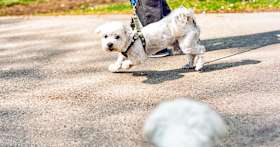
Behavior & Training
Your guide to identifying why your pup is barking so much at other dogs, and how to curb that behavior.