Six Reasons Why Beagles Make Surprisingly Great Family Dogs
Here’s exactly why Beagles can make terrific additions to your household.
Here’s exactly why Beagles can make terrific additions to your household.
by Jackie Brown, | November 24, 2025

bernardbodo /Adobe Stock
If you’re looking for a great family dog, look no further than the charming, gregarious Beagle. Beagles check a lot of “family dog” boxes: They’re small but sturdy, extremely friendly and affectionate, fun-loving, and have abundant energy to play all day with kids.
Read on to learn about the wonderful Beagle, including the breed’s history, size, personality, and care needs.
TL;DR: Beagles make excellent family dogs due to their friendly, gentle temperament and love of children, though their high energy levels require regular exercise and mental stimulation. Beagles are pack animals who thrive on companionship and get along well with other pets, but their strong hunting instincts and stubbornness can make training challenging.
The Beagle is a small to medium-sized hound breed. They were originally developed to chase after rabbits in large packs, while hunters followed on foot. Beagles are categorized as “scenthounds,” which means they track down prey based on their incredible sense of smell. Modern Beagles retain the high energy of their ancestors, as well as their outstanding scenting abilities and high prey drive (or instinct to chase after small critters). If a Beagle catches the scent of something interesting, they’ll try to track it down.
The Beagle temperament is one of the breed’s standout traits. Beagles are social and outgoing, happy to greet everyone they meet. They love people of all ages, especially kids, and get along great with other dogs. Whether or not a Beagle can live with a cat depends on both pets. As long as the Beagle doesn’t try to chase the cat, things are usually peaceful.
Purebred Beagles come in two sizes. Smaller Beagles are 13 inches tall at the shoulder and under, and usually weigh less than 20 pounds. Larger Beagles are 13 to 15 inches tall, and weigh 20 to 30 pounds. Beagle mixes might be a little smaller or larger than these averages. Their compact sizes make it easy for a Beagle to hop in the car and squeeze in next to the kids to head to a park or sports field.
The Beagle’s short, wash-and-wear coat is a breeze to groom. They do shed a fair amount, but quick, daily brushing can help. The Beagle’s droopy ears should be checked weekly and cleaned when dirty to prevent ear infections.
Although the list of wonderful Beagle traits is long, this breed does come with a few challenges.
PixieMe / Adobe Stock
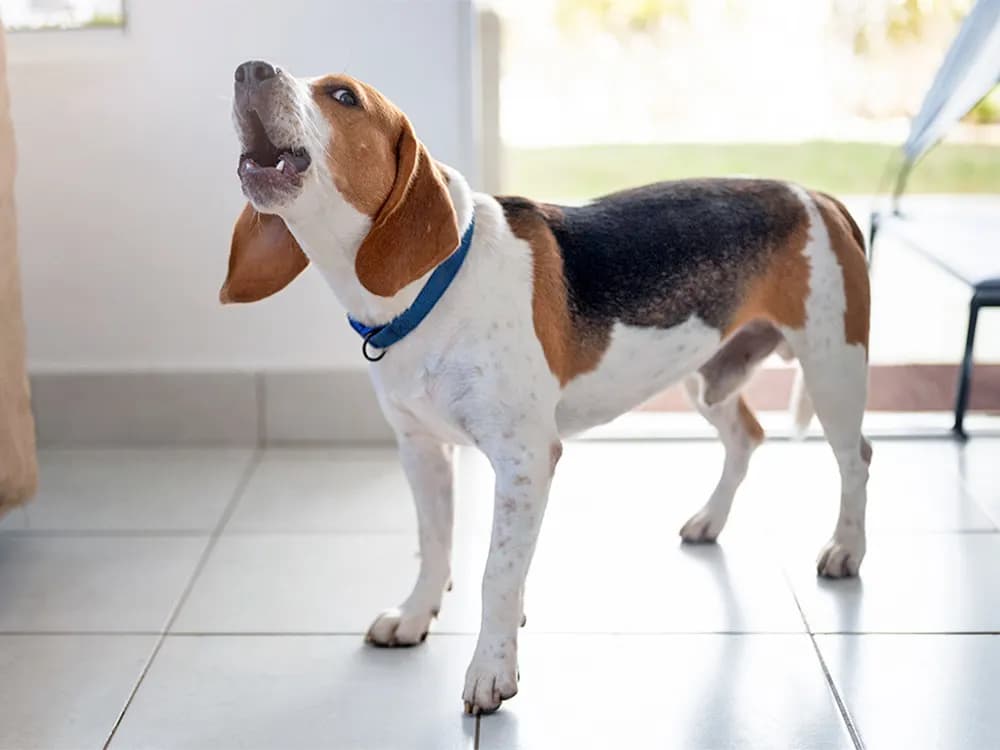
Beagles tend to be very vocal, expressing themselves through a variety of melodic sounds, including baying, howling, and barking. Although you can take steps to reduce barking and howling, this isn’t the best breed for people who are intolerant of noise.

standret / iStock
Beagles also have a ton of energy. This is great if they are working in a field all day, but less wonderful if they are spending a lot of time at home. Without enough exercise, Beagles might turn to destructive behavior to alleviate boredom and pent-up energy. This might look like digging, chewing, escape attempts, or (more) barking. Long walks, hikes, and games of fetch can help burn off a Beagle’s energy so they can be more chill at home.

Adrian Rodd / Stocksy
Beagles are smart, and they do want to please you. But Beagles also have a stubborn side: They might not always feel like following your rules. During training sessions and other times you want them to listen, Beagles can be highly distracted by their sensitive noses and choose to pay more attention to the interesting smells wafting through the air than to what you’re asking them. On the plus side, Beagles love food, so positive-reinforcement training using treats and food will get the best results.

Sorapop / iStock
Many Beagle characteristics make this breed excellent for families with kids. Here are a few reasons why Beagles make great pets:
Beagles love people. Adults, kids, teenagers, friends, family, strangers, you name it — Beagles adore them all. Historically, Beagles lived and worked in packs of many dogs, so they tend to get along great with other dogs, too, whether they live with them or meet them on the street.
Beagles are not so big that they’ll knock over smaller kids, but they are solidly built and unlikely to be hurt by rambunctious play.
Kids will have a blast teaching their Beagle fun tricks using tasty treats to reward them for getting it right.
Beagles love to run and play. These energetic dogs pair well with kids — you can take bets on who will tire out first.
Beagles delight in meeting new people and going on new adventures, whether that’s camping, hiking, soccer games, or simply hanging out on the patio of your local ice cream parlor (hoping for a small lick or two).
Beagles want nothing more than to be close to the people they love. After an afternoon of play, they will happily climb into a kid’s lap for some snuggles before dinner.
Beagles and kids are as perfectly matched as peanut butter and jelly, but it’s important to teach kids how to safely act around any dog — no matter how friendly and tolerant the dog is.
An adult should always supervise play between kids and dogs, so they can intervene if something is dangerous or if the dog seems uncomfortable.
Make certain places, such as the dog’s crate or bed, off-limits to kids. This gives the dog a safe place to retreat if they need space or a break.
Do not let kids lie on the dog or hang around their neck. Most dogs find such interactions uncomfortable, even if they don’t let on.
Respect the dog’s communication. Dogs can’t talk, but they can communicate using body language. If the dog is trying to move away, whining, growling, or panting heavily, instruct the kids to give the dog some space.
Never bother the dog when they are eating, drinking, or going to the bathroom.
Many families wonder when their kids might be ready for a dog. Although there are always exceptions, most experts recommend waiting to get a dog until your youngest child is five years old. This is the age at which most kids have the maturity and impulse control to interact safely with a dog. This is also the age when kids start becoming more independent, which means parents have more bandwidth to care for the needs of a new furry family member.

Preparing for a new puppy with kids? Read our guide for insights on creating a harmonious bond between your children and new puppy.
All kids — and parents — are different. Some five-year-old children might not be ready for a dog, and some kids might be ready sooner. Kids can help with some of the family dog’s care starting from a young age, but remember that the parents are ultimately responsible for the dog.
Yes, Beagles are great with kids. Beagles are friendly, playful, enjoy interacting with kids, and are on the smaller side, but are not too delicate.
Beagle puppy characteristics are similar to many puppies. Beagle puppies are affectionate, playful, and display bursts of energy throughout the day, mixed in with downtime for naps.
“‘5 Tips for Successful Dog Training.’” Vetmed.vt.edu, 19 Jan. 2023, vetmed.vt.edu/news/2023/dog-training-tips.html.
“The Beagle: Energized Pups – Blog of Dogs.” Psu.edu, 31 Oct. 2017, sites.psu.edu/burkepassion/2017/10/31/the-beagle-energized-pups.
Fhsu.edu, 2022, www.sjalba.infprojects.fhsu.edu/web%20dev%20final%20project/beagle.html.
Podella, Carli. “Beagle Care.” Uww.edu, 22 Sept. 2021, blogs.uww.edu/beaglecarecomm285.
“Training ‘Stay’ vs. ‘Wait’ | Cornell University College of Veterinary Medicine.” www.vet.cornell.edu, www.vet.cornell.edu/departments-centers-and-institutes/riney-canine-health-center/canine-health-information/training-stay-vs-wait.
“Your Child’s First Pet.” Children’s Hospital of Philadelphia, 2025, www.chop.edu/primary-care/your-child-s-first-pet.
Jackie Brown lives in sunny Orange County, CA, where she works as a freelance writer and editor. When she’s not on deadline, you can find her paddling her outrigger canoe in the Pacific Ocean or hiking in the foothills with her miniature poodle and two young boys.

Adoption Advice

Behavior & Training

Breed Info

Shelters & Rescue
These dog breeds often fill shelters — discover the reasons behind their frequent surrenders.

Adoption Advice
If your dog is intense about protecting their food, it’s important to address their behavior. Here’s how.

Pet Wellness
Forget the “seven-year rule.” Here’s how dogs really age.
Behavior & Training
Why dogs bark, when it’s not normal, and how to curb this behavior.

Behavior & Training
If your normally sweet pup is lashing out when unexpectedly woken up, don’t despair. There are some steps you can take to soften this behavior.
Adoption Advice
Who says names have to be long and complicated? One-syllable dog names are easy to say and perfect for training.