What Tabby Cat Patterns Can—And Can’t—Tell Us About Behavior
From classic swirls to mackerel stripes, these patterns come with reputations.
From classic swirls to mackerel stripes, these patterns come with reputations.
by Janelle Leeson, | December 30, 2025

olezzo / Adobe Stock
While a cat’s personality can be influenced by breed, it’s shaped just as much by life experiences. Spunky. Affectionate. Courageous. So what do those personality traits have to do with the stripes, spots, or swirls on a tabby cat? Honestly, not much.
“Tabby” isn’t a breed, but these cats have still earned a reputation: orange tabbies are often described as especially friendly and outgoing, while brown tabbies are sometimes seen as more independent and playful.
Keep reading for everything you need to know about tabby cats, including the myths and truths behind their oh-so-lovable personalities.

Carolyn Lagattuta / Stocksy
Tabby is a coat pattern, and an iconic one at that. It features bold stripes, playful spots, or dramatic swirls, and, the most famous feature of all, what looks like an “M” stamped right on the cat’s forehead.
You won’t have to search high and low for a tabby cat because the pattern is found across tons of cat breeds, from Exotic Shorthairs and Norwegian Forest cats to domestic shorthairs. It appears in both long and short coats, and in a large variety of colors.
Tabby is actually the most common coat pattern. Because it’s a dominant trait, if one parent carries the tabby gene, there’s a good chance their kittens will have tabby markings, too.
But it’s not just pet cats who flaunt this swirly look. All domestic cats are descendants of the Near Eastern wildcat — and guess what kind of coat they typically have? You guessed it: tabby. Their gray or yellowish-brown coat with dark stripes helps them blend into their surroundings.

Olga / Adobe Stock
Tabby comes in several patterns, all featuring a base color with darker markings layered on top. Here’s a look at the tabby coat patterns you might see:
Classic tabby: Also called a blotched or marbled tabby, this kitty has a bold, swirling pattern, often looking like a bullseye on the cat’s sides.
Mackerel tabby: Mackerel tabbies have narrow stripes running down their sides, plus one thick stripe along their spine. The mackerel pattern is the “wild type”— it’s the same camouflage of many wildcats.
Spotted tabby: Spotted tabbies have stripes on the face, legs, and tail, but the stripes on their torso are “broken apart” into spots or elongated spots.
Ticked tabby: At first glance, ticked tabbies don’t look striped, other than on the face, legs, and tail. Rather, their coat has a shimmery, salt-and-pepper look. But look closely and you’ll see that each individual hair on their body has bands of multiple colors. This tabby pattern is common in Abyssinians, Singapuras, and their mixes.
Patched tabby: Often seen in white cats with splotches of color, patched tabbies have tabby striping on their colored splotches.
Lynx-point tabby: A point-colored cat has darker “points” of color on their face, ears, feet, and tail. A lynx-point cat has tabby striping over those darker areas. You’ll see this pattern in Siamese, Ragdolls, Himalayans, Persians, Ragamuffins, and their mixes.
Tortoiseshell tabby (Torbie): A tortoiseshell cat has mottled orange-and-black coloring with little to no white. Add in tabby striping, and that’s a torbie.
Calico tabby: A calico tabby has the classic calico look — white with orange and black (or diluted variations) — but with tabby stripes on the colored areas.
Oceloid tabby: The newest addition to the tabby family, this pattern features elongated, flame-like spots. It’s a newer look in domestic cats because it results from breeding a domestic cat with a wild species, as seen in Bengals and Savannahs.

Peter Sterling / iStock
Despite the popular belief online, a cat’s coat color, pattern, or type doesn’t actually determine whether they’re playful, cuddly, or feisty.
Certain breeds do have characteristic traits — a lynx-point Ragdoll might be calm and “melt-into-your-arms” affectionate — but that personality is influenced by their breed, not their lynx-patterned points. However, most domestic cats don’t belong to any recognized cat breed. Rather, they’re random-bred cats with no specific lineage and their “breed” is a description of their appearance: domestic short-, medium-, or long-haired cats.
Purebred or not, cats’ personalities are shaped not only by genetics but by life experiences and environment, too, such as important socialization with humans and other pets in kittenhood. A cat’s age can also play a role.
That said, a tabby coat can still be a reminder of a cat’s wild roots. Those stripes, spots, and swirls are an evolutionary adaptation that allows wildcats to stealthily stalk prey and hide from predators. Even if your tabby’s personality isn’t dictated by their pattern, you can put those stripes to work: daily play that taps into their natural hunting instincts to help keep them happy and healthy.
When it comes to personality, no two tabbies are exactly alike — just like no two cats of any coat color or pattern are the same. Tabbies are often thought of as bold, active, or outgoing, while other colors are assigned different preconceived labels, such as orange cats are friendly and gray cats are shy or aloof. The reality is, there are all sorts of cat personalities and tabbies can be any combination, including:
Some tabby cats can lean extroverted, often inserting themselves into what’s happening, and disliking being left out, even if they’re not always cuddly.
A sociable cat might actively seek attention from many people (and sometimes pets), greet visitors, and enjoy being the center of social activity.
Some tabbies are “velcro cats.” These cats love to cuddle, lap time, and follow their people everywhere. Common signs of affection include headbutts, grooming their favorite people (and other pets), and giving their loved ones slow blinks.
Keeps a bit of distance and prefers observing over interacting in new situations. Quietly affectionate in their own way, content to entertain themselves, yet still enjoys special, one-on-one time with their favorite human.
Comfortable doing their own thing, many independent cats — including plenty of tabbies — have a personality that doesn’t require constant reassurance or nonstop company, preferring affection on their own terms.
A bold tabbie is a confident cat who inserts themselves into nearly every situation and may mark their territory by rubbing against objects — including their favorite humans.
Some tabbies can be slow to warm up, but are comfortable once trust is built. They tend to thrive in quiet environments. These kitties may be suspicious of new objects.
Adaptable tabbies tend to adjust well to changes in their environment and routines, including new pets and people, with proper introductions.
A curious kitty is a natural explorer who investigates new smells, sounds, boxes, and forbidden countertops. Some curious tabbies may explore the world through chewing on everything.
A conversational companion who meows, chirps, and trills to communicate regularly. At times, endearingly demanding “attention-seeking” behaviors.
Easily spooked, shy around strangers, and prone to stress in new environments, this cat may overgroom or prefer hiding under the bed. They tend to form deep bonds with their people, often favoring one special person in particular.
Enjoys chasing, pouncing, and engaging in risky behaviors. Most likely to have post-litter box and midnight zoomies, but may also become easily overstimulated or engage in rough play.

evrymmnt / Shutterstock
And sure, assigning personalities based on coat color can be fun — it’s part of the lore of being a cat person. But taken too seriously, cat color stereotypes can do more harm than good. These assumptions can influence how cats are treated and whether they’re adopted at all.
So, look beyond coat color when adopting. Instead, talk with shelter staff or volunteers who spend time with the cats. They can offer valuable insight into each cat’s personality.
When searching for adoptable pets on Adopt a Pet, you can filter pets by traits, such as whether they’re good with kids or other pets. Each profile also shares why the pet needs a new home and often includes a sweet story to help potential adopters like you get to know them better.
You can also filter by age, including kitten, adult, or senior. Adopting a kitten can give you even more opportunity to help shape behavior, because personality is heavily influenced by environment, socialization, and early life experiences, not just genetics — and definitely not coat color or pattern.
Tabby cats have all sorts of personalities because “tabby” is a coat pattern, not a breed.
No, a cat’s personality is influenced by a combination of genetics, environment, and life experiences.
There is no difference. A tabby cat is a “normal” domestic cat, just with a striped, spotted, or swirled coat pattern and a signature “M” marking on the forehead.
Coat color doesn’t determine how friendly a cat is, but genetics can influence a cat’s temperament. Some of the friendliest cat breeds include the Ragdoll, Ragamuffin, British Shorthair, Bombay, and Birman. But, ultimately, any cat can be friendly because personality is shaped by environment and early life experiences, not just genetics. “A kitten that grows up around people and gets lots of love usually becomes friendly and confident,” says Dean Vicksman, DVM, CVJ, of EveryCat Health Foundation.
Daniels, Mike J., et al. “Ecology and Genetics of Wild-Living Cats in the North-East of Scotland and the Implications for the Conservation of the Wildcat.” Journal of Applied Ecology, vol. 38, no. 1, Feb. 2001, pp. 146–161, https://doi.org/10.1046/j.1365-2664.2001.00580.x.
Driscoll CA, Menotti-Raymond M, Roca AL, Hupe K, Johnson WE, Geffen E, Harley EH, Delibes M, Pontier D, Kitchener AC, Yamaguchi N, O’Brien SJ, Macdonald DW. The Near Eastern origin of cat domestication. Science. 2007 Jul 27;317(5837):519-23. doi: 10.1126/science.1139518. Epub 2007 Jun 28. PMID: 17600185; PMCID: PMC5612713.
González-Ramírez MT, Landero-Hernández R. Cat Coat Color, Personality Traits and the Cat-Owner Relationship Scale: A Study with Cat Owners in Mexico. Animals (Basel). 2022 Apr 15;12(8):1030. doi: 10.3390/ani12081030. PMID: 35454276; PMCID: PMC9024431.
Plitman, L., Černá, P., Farnworth, M. J., Packer, R. M. A., & Gunn-Moore, D. A. (2019). Motivation of Owners to Purchase Pedigree Cats, with Specific Focus on the Acquisition of Brachycephalic Cats. Animals, 9(7), 394. https://doi.org/10.3390/ani9070394
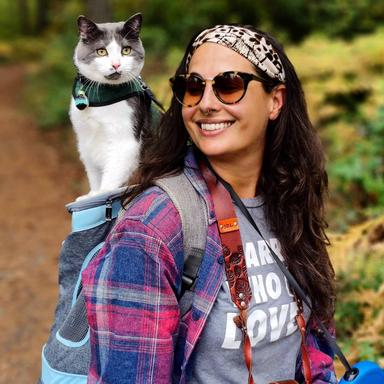
Janelle Leeson is a Portland, Oregon-based freelance writer. Her work has been featured in magazines such as Inside Your Dog’s Mind, Inside Your Cat’s Mind, and Paw Print, as well online at Insider Reviews, NBC Select, Shop Today, PetMD, and Daily Paws. She has two adventure cats, a flock of urban chickens, and a soon-to-be-husband who doesn’t mind housing the occasional foster cat — or five.