How Often Do Dogs Need to Go Outside?
This guide to bathroom breaks will help prevent accidents and keep your dog healthy.
This guide to bathroom breaks will help prevent accidents and keep your dog healthy.
by Dr. Maria Zayas, DVM, | April 9, 2026

yta / Adobe Stock
Trying to meet the needs of your canine bestie when they don’t communicate the same way you do can be hard. When you’re balancing work, exercise, and puppy parenting, how do you know what’s fair to ask of your dog when planning bathroom-break timing into your busy daily life? Below, you will find help to determine a good schedule to follow.
All estimates for how long a dog can wait between bathroom breaks are estimates and vary by age, size, medical needs, and personal doggie preferences.
Puppies can generally be expected to wait about one hour for each month of their age between potty breaks, for up to six hours.
Adult dogs need to go out every four to eight hours to maintain a healthy urinary tract and stay comfortable.
The canine urinary tract is a sophisticated multiple-organ waste-management system that works to filter toxins and regulate hydration.
It starts with the kidneys, which filter water, electrolytes, toxins, and more out of the bloodstream to create urine. The goal is to keep a dog’s blood healthy, clean, and circulating well.
The next step in the urinary system is the bladder, which stores urine that the kidneys make until a dog is ready to pee. To get from the kidney to the bladder, the urine flows through a small connecting “pipe” called a ureter. (Each kidney has one ureter connecting it to the bladder.)
Once a dog is ready to pee, they open the flood gates — also known as the bladder sphincter — and the urine flows into the urethra. This is the tube it travels through to exit the body.
A dog knows they need to pee when stretching of the bladder wall tells them their bladder is full. The larger the stretch, the more urgency they feel.
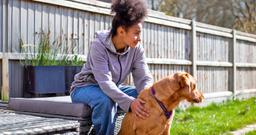
If it seems impossible, don’t fret. Every dog can be house-trained.
Although a stretched bladder wall lets a dog know they need to pee, this does not tell the kidneys to stop making urine. Remember that the kidney’s only priority is keeping the bloodstream in tip-top shape — urine is just a secondary by-product of that job.
If a dog cannot go pee when they need to, the bladder will continue to fill with urine and can become enlarged and overstretched. In emergency cases, where a dog physically cannot urinate due to problems such as urinary obstructions or nerve damage, the bladder can fill to the point of bursting. If this happens, urine leaks into the abdomen, and that is a life-threatening emergency.
When urine spends too much time in the bladder, some of the following problems can develop.
Urine that sits around for too long in the bladder is more likely to collect bacteria, which can lead to an infection. If the urine is too dilute, is not acidic or basic enough (has an abnormal pH), or has sugar in it due to stress or diabetes, that makes a UTI even more likely. The lower urinary tract (like the urethra) depends on urine at a certain pH to regularly wash out the area and prevent bacteria from spreading.
Urine that is at an abnormal pH and sits around in the bladder for too long can start to develop crystals. These crystals can even stick together and grow into bladder stones, which may get stuck in the bladder and require surgery for removal. The longer the urine sits in the bladder, the more likely the pH will shift, and stones will form.
Bladders that become overstretched can have trouble contracting to empty again. Trauma or nerve damage are the most likely causes, but chronic overfilling of the bladder (in dogs who frequently wait too long to go to the bathroom) can lead to this complication as well.

From UTIs and diabetes to the natural effects of aging, several conditions can cause frequent urination in dogs — many of which are highly treatable.
Many important factors determine how long a dog can go without peeing. For most adult dogs, six hours is a reasonable time to go without peeing during the day. Some dogs may be able to wait as much as eight or even 12 hours, while others may develop UTIs or other complications if they wait more than four.
Health conditions such as diabetes, arthritis, hypothyroidism, previous urinary crystal or bladder stone history, or Cushing’s disease can all impact how long a dog can go without peeing. Some medications, such as steroids, can also change a dog’s urination frequency needs.
Generally speaking, while dogs are sleeping, their metabolism is slower, and they can wait longer before needing to pee. Depending on their sleeping habits, this usually means you can have a longer stretch overnight without potty breaks.
A dog’s size, breed, age, health, training, and life experience can all change their needs. These guides are just a starting point in determining how long your dog can go without peeing.
Here are a few that’s that impact a dog’s ability to “hold it.”
The general rule of thumb is that a puppy can hold their bladder for about one hour for every month of their age. So a four-month-old puppy can hold it for about four hours, give or take an hour. After about six months, most puppies can hold it about the same amount of time as an adult dog, which is six to eight hours.
Adult dogs need to pee about every six hours to maintain good urinary health. Some will be just fine for eight hours or so, but although they may be capable of holding it for longer than that, it isn’t considered good for them.

Yes, your dog peeing themselves can be frustrating, but they’re not doing this intentionally. Here’s what urinary incontinence may indicate — and what you should do.
Senior dogs often need to go pee more frequently than adult dogs. This is because they can develop health conditions or take medications that cause them to need to go more often. How often depends on their health conditions.
Seniors with arthritis may have trouble squatting long enough to fully empty their bladders, and thus need to go out every four hours. They also may try to put off going because it hurts, so you may be the one insisting on that schedule. Medications such as steroids can cause a dog to drink more and pee more, meaning they may need to pee every two to three hours to avoid accidents.
If you’re seeing changes in how often your senior dog needs to go pee, talk to your vet about it, and see if there’s anything you can do to help.
In simplest terms, smaller dogs have smaller bladders. But smaller dogs also have a smaller blood volume and smaller kidneys that make a smaller amount of urine. So what’s really happening when small dogs need to go out more often than large dogs?
Smaller animals, like small and toy breed dogs, have a higher metabolism. This means that for their size, they need to drink more and pee more than you’d expect.
You can safely shave one to two hours off the estimated time a large dog can hold it, to estimate how often a small dog needs to go pee. That means about every four to five hours.
Having a dog who benefits from potty breaks every four hours, even when they’re adults, can be a lot to handle. Smaller dogs are also at a greater risk of predator attacks, so having a doggie door isn’t always a safe solution (or even possible if you live in an apartment).
Some ideas to help meet both you and your small dog’s needs include:
Pee pad training
Dog walkers
Litter box training
Protected yards combined with a doggie door

Discover when nighttime crating makes sense, when it doesn’t, and how to make it a positive experience.
Although dogs can’t tell us they need to go out, they do alert us in their own language. Here’s what to look for:
Pacing
Circling
Sniffing the ground
Moving out of your line of sight
Walking to the door to the outside
Whining
Barking
General restlessness
Episodes of play and waiting, but not sleeping in between
Soliciting eye contact
Dogs usually need to pee about four to five times a day.
Although some dogs may be capable of holding their pee for 12 hours, especially if they’re in a kennel, that doesn’t mean that they should do that — or that there won’t be consequences. Holding their pee for 12 hours can cause pain, UTIs, bladder wall damage, or irritation.
Yes, dogs who have eaten (especially wet food) or had water in the last hour are more likely to need to pee soon.
The Ohio State University Veterinary Medical Center. "Indoor Pet Initiative: Dogs." 2023. https://indoorpet.osu.edu/dogs.

Dr. Maria Zayas attended Ross University School of Veterinary Medicine where she completed her veterinary degree in addition to participating in and presenting research related to aquatic animal medicine. She spent her first year as a doctor working with a low cost spay/neuter and general practice clinic before returning to her home state of New York and entering the world of housecall veterinary medicine. Falling in love with this area of medicine, she launched her own housecall veterinary practice in addition to writing pet health articles. She loves all things related to water and continues to travel and explore with her three dogs and one cat, all of whom also love to swim.
Pet Wellness

Behavior & Training
Behavior & Training
Behavior & Training
What does it mean when your pup raises their eyebrows, pulls their ears back, or yawns a lot? Read on for all the answers.
Adoption Advice
Find out why big dogs are basically the ultimate pets. We lay it out for you here.
Behavior & Training
Your guide to identifying why your pup is barking so much at other dogs, and how to curb that behavior.
Adoption Advice
Considering dog adoption? Learn the differences between adult dog and puppy adoption to find your perfect match.
Behavior & Training
Here’s what may be going on — as well as some tips on how to fix this unfortunate behavior.
Behavior & Training
Some dogs just need a bit of training and encouragement to help them overcome undesired behaviors.