Cat Spraying: Let’s Talk About Causes and Fixes That Actually Work
Yikes! Is your cat spraying? Read more to learn why cats spray and effective methods to stop this behavior.
Yikes! Is your cat spraying? Read more to learn why cats spray and effective methods to stop this behavior.
by Adrienne A. Kruzer, BBA, RVT, LVT, | March 18, 2024
cunfek / iStock
Did you just discover that your cat has been spraying? It’s more common than you might think. The harsh reality is that some cats spray indoors. Spraying once or twice a year (while super gross) isn’t cause for concern, although it’s not much fun to clean up. Read on to learn more about why cats spray outside the litterbox and a guide for preventing your cat from spraying.
TL;DR: If your cat sprays more than once a week, you have a behavior that could soon become a hard-to-break habit. Cat spraying is widely misunderstood, but it can sometimes be solvable by identifying root triggers and applying modifications or treatments. Patience — coupled with cleaning, vet assessments to rule out health conditions, and positive reinforcement — can help increase the likelihood of an odor-free future for you and your cat.
Cat spraying is a behavior in which felines spread their urine onto a surface such as a wall or piece of furniture. Spraying can occur in both male and female cats. It is messy and smelly, and if your cat does this, it means that your cat is trying to tell you something.
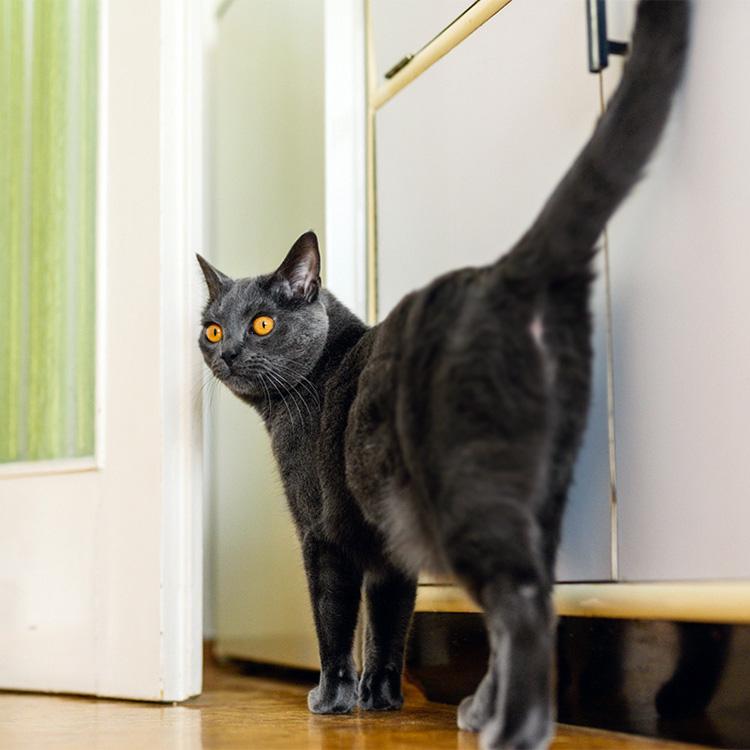
When a cat pees normally, they squat and empty their bladder into a litter box, leaving a puddle of urine that is absorbed into the litter. When a cat sprays, they are still peeing, but they’ll (usually) stand, raise their tail, and wiggle it as urine is sprayed vertically, usually onto a wall, curtain, or piece of furniture. Unlike when they’re peeing normally, the bladder usually isn’t emptied when a cat sprays. Cats purposefully spray as a means of communication, while they pee to simply relieve their bladders.
Why cats pee depends on a variety of factors, including sex, health, and behavior. Cats communicate differently than humans, so the things they do, like spraying, are also often cries for help. It’s helpful to understand the reasons if you want to know how to stop them from spraying indoors.
If your cat has an underlying medical issue, they may be spraying to tell you something is wrong. Cats are very good at masking pain so they may spray to express their discomfort. Diagnosing and treating a medical problem will require a visit to your veterinarian so that an appropriate and effective treatment plan can be made.
Medical issues that can cause your cat to spray include:
Cystitis
Kidney disease
Gastrointestinal disease
Arthritis
Just because your cat suddenly starts spraying doesn’t mean that a medical issue just started though. The medical issue may have been going on for a while or could have suddenly started so a full work-up by your veterinarian may be warranted to figure out if there’s an underlying medical issue for your cat’s spraying.

Here are a few tips to help you pick the right vet.
If a vet has ruled out a medical problem, the underlying reason for your cat to be spraying is a behavioral one. There are a variety of reasons why a cat may feel stressed, and all of them can cause them to spray.
Some common behavioral reasons for a cat to start spraying, among many other things, include:
Territorial feelings from having a new person or pet in the household, or your indoor cat has smelled or seen an outdoor cat.
Stress and anxiety can come from things like construction in or around the home, the type of food, litter, or litter box being changed, or there not being enough litter box options for all of your cats.
Sex drive can be a cause of spraying if your cat is in heat or smells another cat in heat.
It can be difficult to determine the root cause of your cat’s behavioral issues, so if you are unable to solve the problem by yourself, veterinary professionals specialized in behavior are available to help.
The things you can do to stop cat spraying will vary depending on why your cat is spraying in the first place.
If you don’t see any obvious environmental reason for your cat to suddenly start spraying, you’ll want to get your cat checked out by your veterinarian. A full physical exam alongside diagnostic testing, such as blood work, urine tests, X-rays, and an ultrasound, may be recommended in order to determine your cat’s health status. If there are any abnormalities in the physical exam or test results, your veterinarian will hopefully be able to make a diagnosis and recommend an appropriate treatment plan.
Depending on the diagnosis, treatment may include medications, supplements, dietary changes, or even surgery. Depending on the diagnosis, these treatments may be temporary or permanent lifestyle changes. If there are no abnormalities in your cat’s check-up or test results, a discussion surrounding your cat’s environment and any potential stressors and anxiety triggers should be held.
A cat’s spay and neuter status can play a role. Eliminating a female cat’s ability to go into heat and the sex drive of both males and females may be the solution to your spraying problem. For male cats in particular, having them neutered before the age of five and a half months has been shown to decrease urine spraying behavior.

Too much of a good thing is not a good thing. Find out why spaying or neutering is a smart choice for your pet and the community.
A cat who is spraying because they are stressed needs help. Using feline pheromones in your home is one way to help decrease your cat’s stress but whenever possible, you’ll also want to eliminate the source of the stress. This can be easy to do if the stressor is something like a new litter box or house plant but if it’s a person or pet, it’s unlikely you’ll be able to make the environmental change your cat is requesting.
In addition to the pheromones, you may want to discuss giving anxiety-reducing medication to your cat or using calming foods or supplements with your vet. These options may help provide enough stress relief to your cat that they stop spraying temporarily if the stressor won’t last forever, such as construction or a visitor in your home.
To discourage continued spraying, a thorough cleaning of the marked area should be done as soon as you notice the mess, along with treatment for the underlying medical or behavioral issue. A special enzyme-based cleaner should be used instead of a cleaning solution that temporarily masks the smell. This will help prevent your cat from wanting to spray in that same spot again and destroy the odor so you don’t have to keep smelling it. Follow the instructions on the enzyme cleaner to get the best results.

Cats are fastidious about their own cleanliness, but that doesn’t mean you won’t need to give them a little help along the way. Here’s how.
Thankfully, it’s not difficult to train a cat to use a litter box. When a cat pees or poops, they will naturally want to bury their waste. By simply providing your cat with a clean container that contains a loose substrate-like litter, your cat will want to make use of it. Be sure your cat has an appropriately sized litter box with litter that’s about one to two inches deep. At least one edge of the litter box should be low enough for your cat to easily get into and out of the box on their own and enough space to turn around and scratch.
If you have a new kitten, gently set them in one of their litter boxes when you bring them home so they know where at least one of their boxes is and allow them to climb and explore on their own. Cats of any age should have access to their litter boxes at all times, the litter boxes should be placed in quiet areas, and there should be at least one more litter box than there are cats in the home to give everyone options to use.
A Meta-Analysis of Studies of Treatments for Feline Urine Spraying
Current Perspectives on the Optimal Age to Spay/Castrate Dogs and Cats

Adrienne Kruzer is an accomplished veterinary technician and writer with over 15 years of hands-on experience caring for domestic and exotic animals.

Adoption Advice

Pet Wellness
Adoption Advice

Behavior & Training

Adoption Advice
Here are some important factors to consider when deciding how big to grow your feline family.

Behavior & Training
Your cat’s attempts to make a run for it are usually pretty normal. Here’s how to prevent their temptation to explore the great outdoors.

Adoption Advice
Find out how these cats compare and which is right for you.

Behavior & Training
Is your cat refusing to use their litter box? Explore these tactics to address and resolve this issue.
Adoption Advice
Stressed about raising your kitten? This National Kitten Day, we’ve got you covered with everything you need to raise a happy, healthy cat.